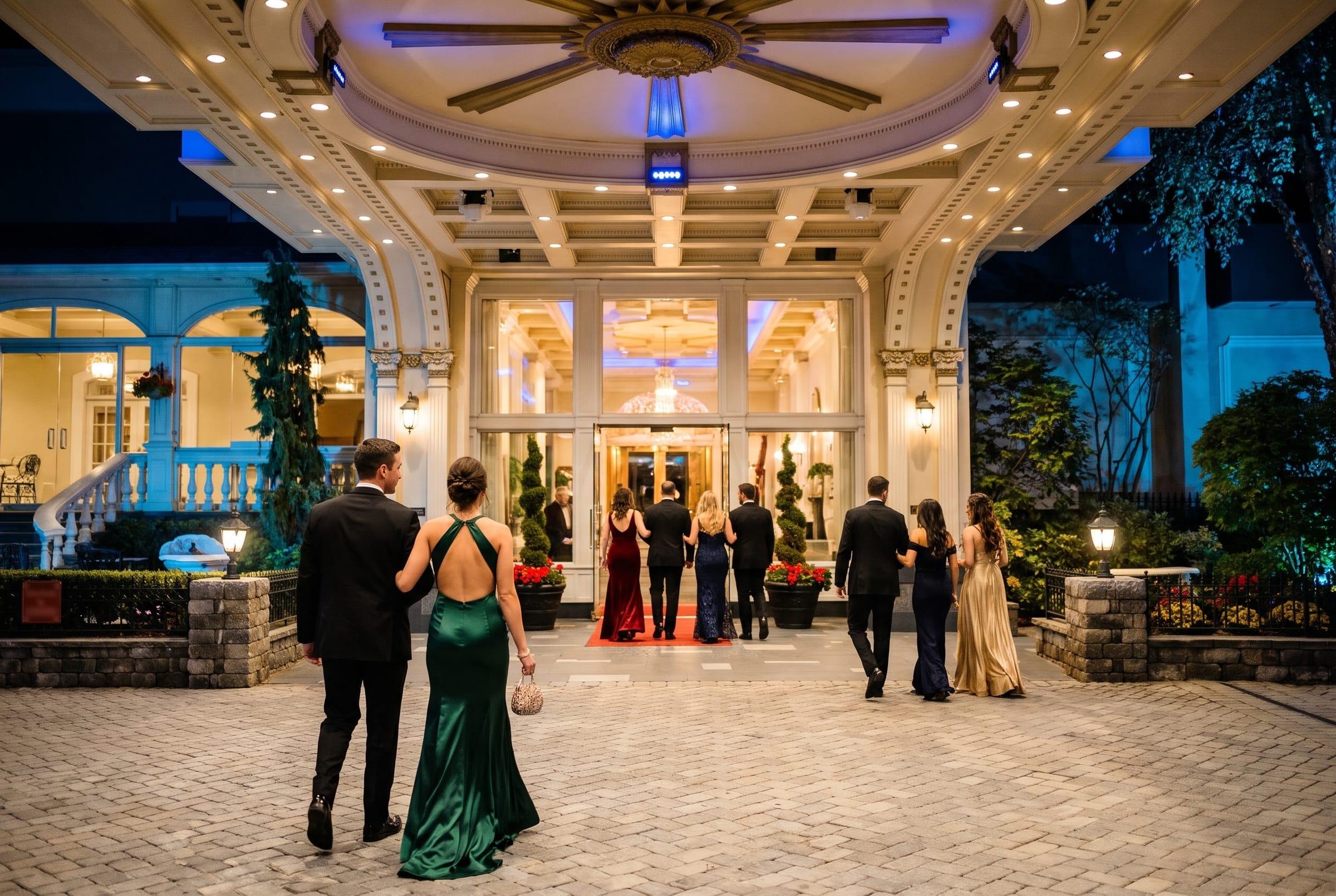

Ask most hosts how many valet attendants their event needs and they'll start with the guest list. It's a reasonable instinct, but guest count is only one of several numbers that decide whether event valet parking in NJ runs smoothly or leaves a line of cars idling at the curb. This guide walks through the factors we weigh when we staff an event, and a simple way to estimate the number yourself before you call.
Why guest count alone doesn't answer it
Two events with the same 150 guests can need very different teams. Picture a dinner where guests drift in over an hour and park twenty steps from the door. Now picture a wedding where nearly everyone arrives in the fifteen minutes before the ceremony, and the only parking is a lot down the road. The second event might need three or four times as many attendants, even though the guest list is identical.
What actually matters is how many cars need to be parked at the busiest moment, and how long each one takes.
The four things that decide your number
1. The arrival window
Valet staffing is planned around the peak, not the average. If most of your guests will arrive in a short window, such as just before a ceremony or a seated dinner, the team has to absorb that wave without a queue forming at the entrance. Events with a loose start time, like an open house or an evening reception, spread arrivals out and need fewer people.
2. The run
The "run" is the round trip an attendant makes: drive the car to its space, park it, secure the keys and walk or jog back to the stand. A run on a compact property might take two or three minutes. A run to a lot several hundred yards away, or up a long estate driveway like many in Alpine, can take ten. Longer runs mean each attendant parks fewer cars per hour, so you need more of them.
3. How guests leave
Departures are often harder than arrivals. Guests tend to leave in clusters, especially after a final toast or the last dance, and every one of them wants their car right away. A good plan accounts for that second peak with enough attendants still on duty at the end of the night.
4. The property and the weather
Narrow drives, one-way approaches, gates, steep slopes and poor lighting all slow a run down. So does rain. We factor all of it in, which is part of why our team arrives early to walk the route before the first guest turns in.
A simple way to estimate it
Here's a back-of-the-envelope method you can use before your consultation. The numbers below are illustrative only; your actual plan depends on your venue.
- Estimate the cars. Divide your guest count by the average number of guests per car. For events with lots of couples, about two guests per car is a reasonable starting assumption.
- Find the peak. Estimate how many of those cars will arrive in your busiest 15 or 20 minutes.
- Time the run. Estimate the round trip in minutes for one car.
- Do the math. Each attendant can complete roughly (peak window ÷ run time) cars during the peak. Divide your peak cars by that figure.
Then add someone to run the stand and manage keys, so the runners can keep running.
The last row is the important one. When the run gets long, staffing climbs quickly. That's usually the moment to look at a different approach rather than simply adding more people.
When to add traffic management or a shuttle
Valet works best when parking is reasonably close to the entrance. When it isn't, two other services can take pressure off the valet team:
- Event traffic management places parking attendants in the lot and along the approach, so self-parking guests are guided to spaces and the line keeps moving. It's useful when some guests valet and others park themselves, or when several lots need filling in order.
- Event shuttle service moves guests from a remote lot or hotel to the front door. Instead of attendants running long distances with every car, guests park once and ride in together.
Many larger events use a mix. A common pattern is valet at the door for older guests and the wedding party, with a shuttle from the overflow lot for everyone else.
City venues are their own puzzle
In dense areas such as Fort Lee, the constraint is usually the curb rather than the distance. Loading zones are short and garage entrances can be slow, so the plan focuses on keeping drop-off quick and orderly. The run may be short, but the number of cars arriving at once can still be high.
What to have ready for your consultation
You'll get the most accurate recommendation if you can share:
- Your event date, start time and any timed moments, such as a ceremony or a seated dinner.
- Your guest count and a rough sense of how many will drive.
- The venue address and where cars can be parked.
- Anything unusual about the property: gates, long drives, steps, or limited lighting.
- How the evening ends, and whether guests are likely to leave together.
With those details, we can size the team, set the positions and tell you whether valet alone will do, or whether traffic management or a shuttle would serve your guests better. You can read more about how we staff events on our valet parking services page, or request a quote and we'll take it from there.
Let's Plan Your Event Parking
Send your date, venue and guest count. We'll recommend valet, traffic management or a shuttle, whichever fits.